
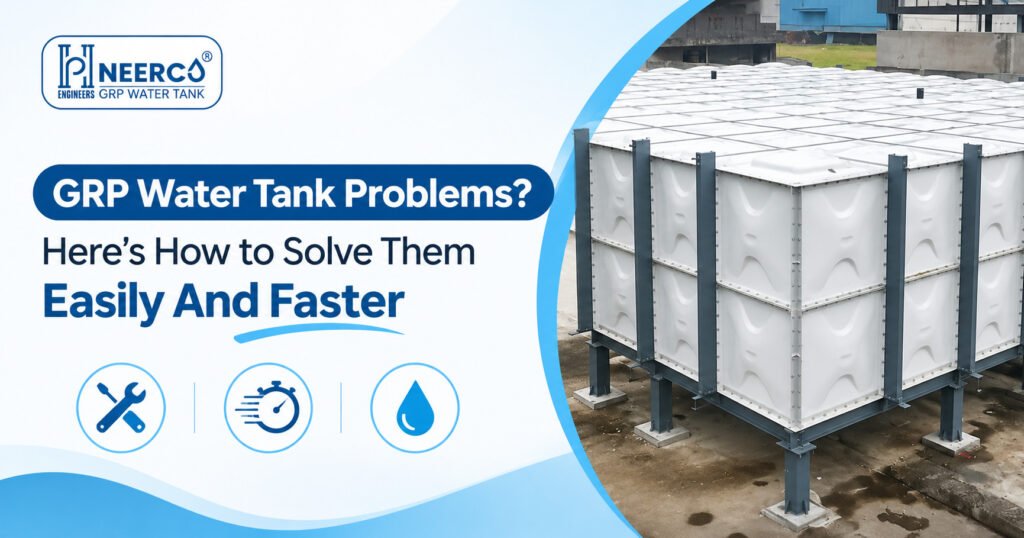
Most GRP water tank problems come from leaking joints and gaskets, algae growth, surface cracks, faulty fittings or a weak base. Find the cause first: check where water appears, how the tank looks inside, and whether the base is level. Small issues can be fixed with routine maintenance; structural or recurring leaks need a trained technician.
GRP water tanks are popular in homes, apartment buildings, factories and commercial sites because they are strong, light and resistant to corrosion. But like any water storage system, they need care. Left alone, small GRP water tank problems such as a weeping joint or a patch of algae can turn into water loss, contamination or a costly repair.
This GRP water tank maintenance guide explains the most common problems, how to troubleshoot them, how to repair and clean a tank safely, and what to check on a regular schedule. It is written for homeowners, housing societies and facility managers, with practical tips from the way panel tanks are installed and serviced.
What Is a GRP Water Tank?
A GRP (glass reinforced plastic) water tank is a storage tank made from fibreglass-reinforced resin. Most large GRP tanks in Indian buildings are sectional panel tanks: moulded square panels bolted together on site, with sealant or gaskets in the joints. Internal stays or tie rods hold the walls against water pressure, and the tank sits on a base frame or plinths.
That construction explains where problems usually start. Joints, bolts, internal stays, the base and the openings (manhole, vent, overflow, inlet and outlet) are the weak points to watch, more than the panels themselves.
GRP tanks are used on terraces, at ground level, in basements and on elevated structures in residential societies, offices, hospitals, hotels and factories, for drinking water, fire-fighting water and process water.
Common GRP Water Tank Problems at a Glance
| Problem | Symptoms | Likely causes | First action |
|---|---|---|---|
| Joint leakage | Drips or wet streaks along panel seams, especially low on the tank | Ageing or displaced sealant, loose or over-tightened bolts, base movement | Mark the leak, lower the water level if safe, call a technician |
| Panel cracks | Hairline or visible cracks, weeping through the panel | Impact, uneven support, over-tightened bolts, pressure from overfilling | Stop using the tank if the crack is growing; get an inspection |
| Bulging or deformed panels | Walls bowing outward, uneven seams | Failed or missing internal stays, poor design, overfilling | Lower the water level; get an urgent structural check |
| Algae and biofilm | Green or slimy walls, musty smell | Light entering through the hatch, gaps or thin panels; infrequent cleaning | Seal light leaks; plan a professional clean |
| Sediment and sludge | Cloudy water, deposits at the outlet, low flow | Silt in the supply water, long gaps between cleaning | Schedule cleaning; check upstream filtration |
| Insects, birds or debris inside | Debris in water, insects near vents | Missing mesh on vents and overflow, an open or damaged manhole cover | Fit or replace mesh; secure the cover |
| Corroded fittings or bolts | Rust stains, seized bolts, leaking connections | Unsuitable metals, moisture, ageing | Inspect and replace with suitable materials |
| Weathered outer surface | Chalky, faded or rough exterior, exposed fibres | Long UV exposure, especially on terraces | Professional assessment; protective coating if suitable |
| Base settlement | Uneven seams, new leaks along one side, gaps under the base | Uneven or weak support, poor plinth spacing | Structural check of the base |
GRP Water Tank Problems Explained
1. Leaks at panel joints
Joint leaks are one of the most common GRP water tank problems. The sealant or gasket between panels can age, shift or be damaged. Bolts can loosen over time from vibration and changing water levels. Over-tightened bolts can crush the seal or crack the panel flange.
Clue: a leak low on the tank usually shows the most pressure on a weak joint. A leak that appears after work nearby, or along one side, may point to base movement.
2. Cracks in GRP panels
GRP is strong, but panels can crack from impact (dropped tools, falling objects), point loads from a poorly supported base, stress from over-tightened bolts, or repeated overfilling. Hairline cracks in the outer surface layer are not always leaks. Cracks that weep water need attention.
3. Bulging or deformed panels
Outward bowing means the walls are carrying more load than they should. Common causes are corroded, broken or missing internal stays, a tank filled higher than its design level, or a tank assembled without the right internal bracing. Treat bulging as a priority: lower the water level and have the tank inspected.
4. Algae, biofilm and bacteria
Algae need light and nutrients. They grow where sunlight gets in through gaps around the manhole, damaged panels or translucent sections. Biofilm, a slimy layer on the walls, can form even in the dark if a tank isn’t cleaned for long periods. Both affect taste, odour and water quality.
5. Sediment and sludge
Municipal and borewell water often carries fine silt. Over months it settles on the tank floor, especially where supply is intermittent and the tank fills at high flow. Sludge reduces usable capacity, can block outlets and gives bacteria a place to grow.
6. Vent, overflow and manhole problems
Vents and overflows without fine mesh let in insects, lizards and dust. A blocked vent can affect how the tank fills and drains. A cracked or poorly fitting manhole cover lets in light, rain and debris.
7. Corroded metal parts
The GRP itself doesn’t rust, but bolts, stays, ladders and pipe fittings can, if unsuitable materials were used. Rust stains, stiff valves and leaks at pipe connections are the signs.
8. Weathering on terrace tanks
Long exposure to strong sun can weather the outer surface. The panel may look chalky or faded, or show fibres. This is usually a surface issue at first, but it should be assessed before it affects the panel.
9. Base and support problems
GRP panel tanks need a level, evenly spaced support. If the steel frame or concrete plinths settle or corrode, panels take uneven load. That shows up later as leaks or cracks, so check the base whenever a new problem appears.
GRP Water Tank Troubleshooting: Step-by-Step Diagnosis
Use this sequence before calling for repair. It helps you describe the problem clearly and often points straight to the cause.
- Note the symptom. Is it a leak, a crack, bulging, poor water quality or low flow? Take photos and note the date.
- Locate it. Mark the exact panel and joint from outside. Note the height of the leak and the water level at the time.
- Check the water level. Is the tank overfilling? Check the float valve and overflow.
- Check the base. Look for gaps, rust, cracked plinths or uneven seams along the bottom row.
- Check the openings. Look at the manhole cover, vent mesh, overflow mesh and pipe connections.
- Check water quality. Look at clarity, colour, smell and taste at the nearest tap. For drinking water, get a lab test against IS 10500 if quality has changed.
- Decide on urgency. Bulging, growing cracks or fast leaks need prompt professional help. Slow seepage at a joint can usually be scheduled.
Safety: don’t climb onto a tank roof, lean over an open manhole or enter the tank to investigate. Inspect from outside, at ground or terrace level.
GRP Water Tank Leakage Repair
GRP water tank leakage repair depends on where the leak is and what’s causing it. Fixing a joint without correcting a sagging base, for example, usually means the leak comes back.
What owners can safely do
- Lower the water level below the leak, if the supply allows and the building can manage with less storage.
- Keep the area dry and safe, and protect electrical points nearby from water.
- Record the leak with photos and notes, and check whether it grows over a few days.
- Don’t apply household sealants or glues to a drinking water tank. Many are not suitable for contact with potable water and may affect water quality.
Joint leaks: professional resealing
A technician will usually drain the tank partly or fully and dry the area. They then remove the bolts at the affected joint, clean the surfaces, and replace the sealant or gasket with a material suitable for potable water. The bolts are re-fitted and tightened to the manufacturer’s specification. Over-tightening is a common cause of cracked flanges, so the correct torque matters.
Panel cracks: lamination or panel replacement
Small, localised cracks can often be repaired by laminating new glass fibre and resin over the cleaned, prepared area. For drinking water tanks, the resin must be suitable for potable water contact and the repair must cure fully before the tank is refilled. Large cracks, cracks near joints or repeated failures often mean replacing the panel. A sectional design makes that possible without replacing the whole tank.
Bulging panels: structural repair
Bulging is fixed by correcting the cause: replacing corroded or broken internal stays, adding bracing where the design is short, and correcting the base. This is structural work and should be done by the manufacturer or an experienced GRP tank contractor.
Choosing a GRP water tank repair contractor
Before you hire anyone for GRP water tank repair, ask:
- Have they worked on sectional GRP panel tanks specifically, not just plastic or concrete tanks?
- Which sealants, gaskets and resins will they use, and are they suitable for drinking water?
- Will they find and fix the cause, such as the base, the stays or overfilling, and not just the visible leak?
- How long will the tank be out of service, and how will they test for leaks before handover?
- Will they provide a written scope, a photo record and maintenance advice afterwards?
GRP Water Tank Cleaning
Regular GRP water tank cleaning keeps stored water in better condition and lets you inspect the inside of the tank.
How often to clean
Many building maintenance teams schedule cleaning about twice a year. Clean more often if you see sediment, algae or changes in taste and smell, or if the supply water carries a lot of silt. Follow any guidance from your local health authority or water supplier.
What a professional clean involves
- Plan the outage and inform residents or users, since water will be unavailable for some hours.
- Isolate the inlet and drain the tank through the drain valve, safely disposing of sludge.
- Remove sediment from the floor and corners.
- Scrub the walls with soft brushes or non-abrasive pads. Wire brushes and harsh scrapers can damage the GRP surface.
- Disinfect with a disinfectant suitable for drinking water tanks, at the strength and contact time its maker specifies.
- Rinse thoroughly and flush so no cleaning residue is left.
- Inspect joints, stays, fittings and the inside surface while the tank is empty.
- Refill and test. For drinking water, test against IS 10500 after cleaning if required.
Safety: a water tank is a confined space
Entering a water tank is confined-space work. It carries risks of slipping, poor ventilation, chemical fumes and difficulty getting out. Only trained people should enter, with ventilation, a person standing by outside, a safe means of access and appropriate PPE. Never use solvents, acids or bleach mixtures not intended for drinking water tanks.
GRP Water Tank Maintenance Guide: A Practical Schedule
Use this GRP water tank maintenance guide as a starting point and adjust it to your site, supply water and how the tank is used.
| Frequency | Task | Who |
|---|---|---|
| Weekly | Look for leaks, wet patches and overflow running; check the manhole cover is closed and locked | Building maintenance staff |
| Monthly | Check vent and overflow mesh, float valve operation, pipe connections and the base for visible changes | Building maintenance staff |
| Every 3 months | Check water clarity, smell and taste; check bolts and seams from outside; look for rust stains | Maintenance staff or technician |
| About every 6 months | Professional cleaning and internal inspection | Trained tank cleaning team |
| Annually | Detailed inspection of joints, internal stays, fittings, base and the outer surface; water quality test against IS 10500 for drinking water | GRP tank specialist and accredited lab |
| After any incident | Inspect after impacts, structural work nearby, heavy storms or earthquakes | GRP tank specialist |
Keep a logbook of inspections, cleanings, tests and repairs. It helps you spot patterns, such as a joint that keeps leaking, and gives the next technician a history to work from.
Simple habits that prevent most problems
- Keep the manhole closed and locked to keep out light, debris and unauthorised access.
- Don’t overfill. A working float valve and a clear overflow protect the tank from overpressure.
- Keep the roof of the tank clear. Don’t store materials on it or let people walk on it unless it’s designed for that.
- Protect against impact during nearby construction or maintenance.
- Fix small leaks early, before they wet and weaken the base.
Repair or Replace?
| Situation | Usually repair | Consider replacement |
|---|---|---|
| Leak at one or two joints | ✓ Reseal | |
| Small, localised crack | ✓ Laminate | |
| One panel badly cracked | ✓ Replace the panel | |
| Many panels cracked or brittle | ✓ | |
| Bulging from failed stays, structure sound | ✓ Replace stays and brace | |
| Severe deformation or repeated structural failures | ✓ | |
| Tank too small or wrong for current demand | ✓ | |
| Repairs keep failing in the same areas | ✓ (after the cause is found) |
A sectional tank can often be repaired panel by panel. When the tank is old, widely damaged, or no longer suits the building’s needs, a new tank may be the more reliable option.
GRP Water Tank Problems in Indian Conditions
Some issues are more common in India because of climate and supply patterns:
- Strong sun on terrace tanks speeds up surface weathering and can warm stored water, so check for chalking and keep openings sealed against light.
- Intermittent municipal supply fills tanks fast, which stirs up and brings in silt. Plan cleaning around your sediment load.
- Monsoon rain and dust can get in through poorly sealed manholes and unscreened vents.
- Hard borewell water can leave scale on fittings and float valves.
- Seismic zones need correctly designed bracing and anchoring. Check this during any inspection after an earthquake.
How H P Engineers Can Help
H P Engineers (NEERCO), based in Gandhinagar, Gujarat, manufactures GRP panel tanks and SMC panel tanks. Its services include installation, inspection, maintenance and reinstallation. If you’re seeing leaks, bulging or recurring water quality problems in a panel tank, share photos, the tank size and location, and a description of the issue through the contact page.
Conclusion
Most GRP water tank problems have clear causes: joints, bolts, stays, the base, openings and gaps in maintenance. Inspect regularly, clean on a planned schedule and act early on small leaks to prevent most of them. For anything that means draining, entering or opening the tank, use trained professionals, and when damage is widespread, weigh repair against replacement honestly.
Frequently Asked Questions
The most common problems are leaks at panel joints, cracked panels, bulging walls, algae or biofilm inside the tank, sediment build-up, and corroded bolts or fittings. Most come from installation, support, sealing or maintenance issues rather than the GRP material itself.
Joint leaks usually come from ageing or displaced sealant, loose bolts, over-tightened bolts that have damaged the seal, or movement in the base. A technician should find the cause, then reseal the joint with a material suitable for drinking water.
Often, yes. Small, localised cracks can be repaired by laminating fibreglass and potable-safe resin over the prepared area. Badly cracked panels in a sectional tank can usually be replaced individually without replacing the whole tank.
Bulging usually means the internal stays or tie rods have corroded, broken or been left out, or the tank is filled above its design level. Lower the water level and have the tank inspected promptly.
Many buildings clean their tanks about twice a year. Clean more often if you notice sediment, algae, or a change in taste or smell. Follow your local health authority’s guidance where it applies.
Stop light getting in. Keep the manhole closed and sealed, repair damaged panels, and fit covers to openings. Combine this with regular cleaning and disinfection by a trained team.
Not for a drinking water tank. Many household sealants aren’t suitable for contact with potable water. Use only materials specified for drinking water, applied by someone experienced with GRP panel tanks.
Entering a tank is confined-space work, with risks of slipping, poor ventilation and chemical fumes. It should be done by trained people, with ventilation, a standby person outside and proper PPE. Owners can safely do external checks.
Consider replacement when many panels are cracked or brittle, the structure is badly deformed, repairs keep failing, or the tank no longer suits the building’s water demand.
Watch for changes in clarity, colour, taste and smell. For drinking water, have samples tested by an accredited laboratory against IS 10500, especially after cleaning, repairs or a quality complaint.