
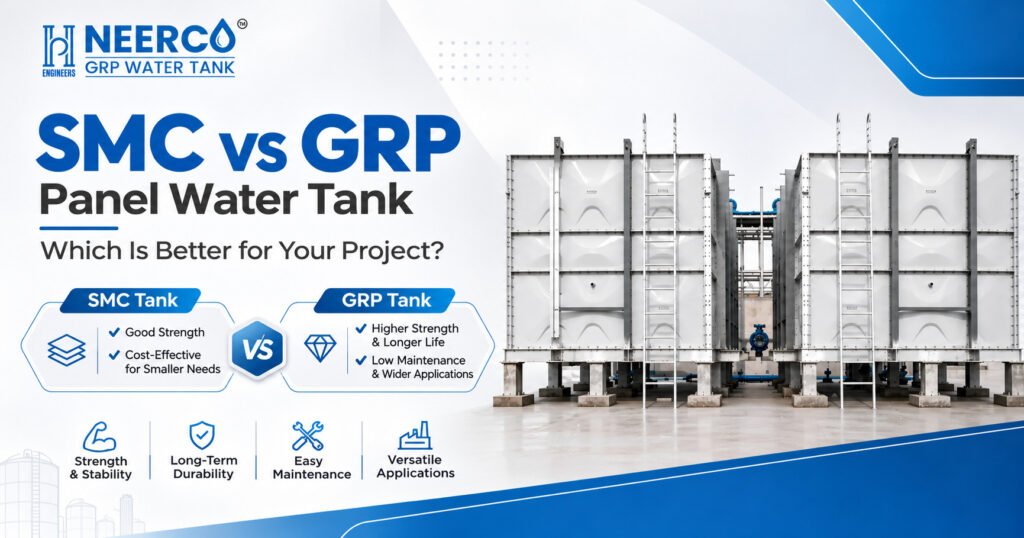
SMC and GRP panel water tanks are both made from glass fibre-reinforced polyester resin. The difference is how the panels are made. SMC panels are hot-press moulded in steel dies, giving consistent thickness, strength and a smooth, non-porous surface, which makes them better for drinking water and large projects. Conventional GRP panels are usually made by hand lay-up or spray-up, cost less to tool and are easier to customise, but quality depends more on workmanship. For most potable water projects, SMC is the safer choice.
Choosing a water tank used to mean choosing between concrete, steel and plastic. Today, modular panel tanks made from fibre-reinforced plastic have become the preferred option for many residential, commercial and industrial projects, because they’re light, rust-free and quick to install.
But buyers often see two terms on quotations: SMC water tank and GRP water tank. They sound similar, and suppliers sometimes use them interchangeably, yet the way the panels are made affects strength, hygiene, consistency and price.
This guide explains what each type is, the difference between SMC and GRP water tanks, how they compare on durability, maintenance and cost, and which suits your project.
It’s written by the team at H P Engineers, which manufactures SMC and GRP panel water tanks under the NEERCO brand at GIDC Chhatral, Gandhinagar, Gujarat. Because we make both types, this comparison aims to show honestly where each one fits.
Understanding SMC Water Tanks
Definition and Composition
An SMC water tank is a sectional tank built from panels made of sheet moulding compound (SMC). SMC is a ready-to-mould sheet of unsaturated polyester resin, chopped glass fibres, fillers and additives.
To make each panel, a measured charge of SMC is placed in a heated steel mould and pressed under high pressure. The heat and pressure cure the resin in minutes, producing a dense panel with uniform thickness, moulded flanges and stiffening ribs.
The panels, typically 1 m × 1 m, 1 m × 0.5 m or 0.5 m × 0.5 m, are bolted together on site with food-grade sealant to form a tank of almost any size. In India, hot-press moulded sectional tanks are covered by IS 14399, which sets requirements for panel materials, strength, potability testing and assembly. Read our guide to IS 14399 requirements for SMC panel tanks.
Advantages of SMC Water Tanks
- Consistent quality: Machine pressing gives every panel the same thickness, density and strength.
- Hygienic surface: A smooth, non-porous finish resists algae and bacteria and is easy to clean.
- High strength: IS 14399 requires a minimum tensile strength of 70 MPa and bending strength of 100 MPa for panels.
- Low water absorption: Dense moulding keeps absorption very low, protecting water quality and panel life.
- Long service life: Typically 25–30 years with basic maintenance.
- Corrosion-free: No rust or chemical attack from treated water.
- Fast installation: Standard panels bolt together quickly, even on rooftops.
- Scalable: From about 1,000 litres to several lakh litres.
Common Applications
- Drinking water storage in apartments, hospitals, hotels and schools
- Rooftop and ground-level tanks for commercial buildings
- Industrial process water and RO water
- Fire water reserves
- Townships, railways and infrastructure projects
Learn more about our SMC panel tanks.
Understanding GRP Water Tanks
Definition and Composition
GRP (glass reinforced plastic), also called FRP, is the general name for plastic reinforced with glass fibre. Strictly speaking, SMC panels are a type of GRP. In the Indian market, though, a GRP water tank or GRP panel water tank usually means a tank made from panels produced by other methods, mainly:
- Hand lay-up: Layers of glass fibre mat are placed in an open mould and saturated with resin by hand, then rolled to remove air.
- Spray-up: Chopped glass and resin are sprayed into an open mould.
- Filament winding or moulding: Used mainly for one-piece cylindrical tanks rather than panels.
These panels use the same basic ingredients as SMC (polyester resin and glass fibre), but they’re cured at room temperature in open moulds without high pressure.
Advantages of GRP Water Tanks
- Lower tooling cost: Open moulds are much cheaper than steel compression moulds.
- Easy customisation: Non-standard shapes, sizes and thicknesses are simpler to make.
- Good corrosion resistance: Like SMC, GRP doesn’t rust.
- Lightweight: Easy to transport and handle.
- Repairable: Damage can often be repaired with additional laminate.
- Suitable for special shapes: Useful for one-off or irregular tanks.
Common Applications
- Non-potable and industrial water storage
- Custom-shaped tanks for restricted spaces
- Agricultural and irrigation storage
- Rainwater harvesting
- Smaller projects where custom sizes are needed
Explore our GRP panel tanks.
Key Differences Between SMC and GRP Water Tanks
SMC and GRP Water Tank Comparison at a Glance
| Feature | SMC panel water tank | GRP (hand lay-up) panel water tank |
|---|---|---|
| Manufacturing method | Hot-press compression moulding in steel dies | Hand lay-up or spray-up in open moulds |
| Consistency | Very high; every panel is identical | Depends on operator skill |
| Surface finish | Smooth on both sides, non-porous | Smooth on mould side; rougher on the other |
| Water absorption | Very low | Can be higher if not well consolidated |
| Strength | High and predictable | Good, but can vary between panels |
| Standard | IS 14399 for hot-press moulded panels | Depends on supplier specification |
| Hygiene | Excellent for potable water | Good if food-grade resin and gelcoat are used |
| Customisation | Standard panel sizes | Easier to customise |
| Typical lifespan | 25–30 years | Varies with quality |
| Best for | Potable water, large and long-term projects | Custom shapes, non-potable and budget projects |
Material Comparison
Both types use polyester resin and glass fibre. The difference is in how they’re combined:
- SMC uses a pre-made compound with controlled glass content, which IS 14399 requires to be at least 30% by weight. Heat and pressure remove voids and create a dense, uniform panel.
- Hand lay-up GRP relies on workers to apply resin and roll out air. Too much resin makes panels brittle; too little or trapped air creates weak spots and porosity.
Durability and Longevity
SMC panels typically offer more predictable durability because every panel is identical and fully consolidated. Well-made SMC tanks generally last 25–30 years.
Hand lay-up GRP tanks can also last a long time when made by skilled manufacturers with good resins and gelcoats, but variability between panels means quality checks matter more. Weak or porous panels can lead to:
- Seepage or leaks
- Fibre exposure on the inner surface
- Surface degradation from UV on rooftop tanks
- Shorter service life
Maintenance Requirements
| Maintenance task | SMC water tank | GRP water tank |
|---|---|---|
| Cleaning | Easy, thanks to smooth surfaces | Easy on gelcoated surfaces |
| Algae control | Opaque, non-porous panels limit growth | Depends on panel opacity and finish |
| Leak checks | Check sealants and bolts | Check sealants, bolts and panel surfaces |
| Repairs | Replace individual panels | Patch repairs or panel replacement |
| Typical cleaning interval | Every 6 months for drinking water | Every 6 months for drinking water |
Cost Analysis
- SMC tanks require expensive steel moulds and presses, but once these are in place, panels are produced quickly and consistently. This makes SMC economical for standard sizes and larger projects.
- Hand lay-up GRP tanks have low tooling costs, so they can be cheaper for small or custom projects. However, labour costs are higher per panel and quality control adds cost.
In practice, prices are often close for standard tanks, and the right choice depends more on application and quality requirements than on price alone.
SMC vs GRP Water Tank: Which Is Better for Your Project?
Factors to Consider When Choosing
- Water use: Is the tank for drinking water, process water, fire reserve or irrigation?
- Capacity: Larger tanks benefit more from consistent, standard SMC panels.
- Location: Rooftop, ground level or underground, and exposure to sun and weather.
- Space and shape: Standard rectangular footprint, or a custom shape?
- Standards and approvals: Does the project need IS 14399 compliance, CPWD approval or potability certificates?
- Budget: Initial cost and long-term maintenance and replacement costs.
- Seismic and wind loads: Rooftop tanks need properly designed supports. See our guide to earthquake-safe rooftop water storage.
- Supplier quality: Testing, documentation, installation and after-sales support.
Recommendations Based on Project Type
| Project type | Recommended option | Why |
|---|---|---|
| Apartments and housing societies | SMC | Hygienic, consistent and long-lasting for drinking water |
| Hospitals, hotels and schools | SMC | High hygiene standards and reliable quality |
| Government and infrastructure projects | SMC | Easier to meet IS 14399 and approval requirements |
| Large industrial plants | SMC | Consistent panels for large capacities |
| Fire water tanks | SMC or GRP | Both work; SMC for long-term reliability |
| Custom-shaped or restricted spaces | GRP | Easier to make non-standard sizes |
| Agriculture and irrigation | GRP or SMC | GRP can suit budget-focused non-potable use |
| Rainwater harvesting | GRP or SMC | Depends on size and budget |
Bottom line: For most potable water and long-term projects, an SMC panel water tank is the better choice. A GRP panel water tank can be a practical option for custom shapes, non-potable uses or smaller budgets, provided it comes from a manufacturer with proven quality.
Questions to Ask Your Supplier
- Are the panels SMC (hot-press moulded) or hand lay-up GRP?
- What resin and glass content do you use, and is the resin food-grade?
- Do the panels comply with IS 14399, and can you share test reports?
- What panel thickness will be used at each level of the tank?
- Are bolts and stays hot-dip galvanised or stainless steel?
- Is installation and a leak test included?
- What warranty do you offer, and what does it cover?
Clear, documented answers to these questions are a strong sign of a reliable manufacturer.
Not sure what size you need? Use our water tank capacity calculation guide.
SMC vs GRP Water Tank Price
Price Comparison
SMC vs GRP water tank price depends far more on capacity, configuration and specification than on the panel type alone. Some useful reference points:
- A July 2026 cost guide by Studio Matrx puts large modular bolted-panel tanks (10,000 litres and above, including GRP) at about ₹6–₹12 per litre, plus the base and assembly.
- For comparison, the same guide lists RCC underground sumps at about ₹8–₹20 per litre all-in.
- Marketplace listings for panel tanks vary widely, from a few rupees per litre for very large tanks to over ₹15 per litre for smaller or highly specified ones.
| Factor | Effect on cost per litre |
|---|---|
| Tank size | Larger tanks cost less per litre, because volume grows faster than panel area |
| Tank height | Taller tanks need thicker bottom panels (IS 14399 Types B and C) |
| Panel type | SMC tooling is costlier, but panels are cheaper at volume; hand lay-up suits small runs |
| Location | Rooftop tanks need stronger supports; underground tanks need more bracing |
| Accessories | Ladders, manholes, level indicators and partitions add cost |
| Support structure | Steel base frames and foundations are often priced separately |
| Transport and installation | Distance, site access and height affect cost |
| Certification | Potability testing and documentation add value and cost |
Figures are indicative only and change with steel, resin and freight prices. Always request a detailed quotation for your exact capacity, dimensions and site.
Factors Influencing Cost
- Resin and glass prices, which change with crude oil and global supply
- Panel thickness and type needed for tank depth
- Steel prices for base frames, bolts and stays
- Grade of fasteners, such as hot-dip galvanised or stainless steel
- Site conditions and installation complexity
- Warranty and after-sales support
Look at Lifetime Cost, Not Just Price
A tank that costs a little less upfront but leaks, needs frequent repairs or must be replaced early is more expensive over its life. For drinking water and critical storage, the consistency and long life of SMC often make it the lower-cost option over 20 or more years.
Conclusion
The SMC vs GRP water tank decision comes down to how the panels are made. Both use glass fibre and polyester resin, but SMC panels are hot-press moulded for consistent strength, a smooth hygienic surface and predictable long life, while conventional GRP panels offer easier customisation and lower tooling costs, with quality that depends more on workmanship.
For drinking water, large capacities, institutional and government projects, an SMC panel water tank is usually the better choice. For custom shapes, non-potable storage and smaller budgets, a well-made GRP panel water tank can work well.
Whichever you choose, ask for test reports, IS 14399 compliance where relevant, clear drawings, a detailed quotation and warranty terms.
Need help choosing? Explore H P Engineers’ SMC panel tanks and GRP panel tanks, see our clients, or contact our team for expert advice and a free quotation.
Frequently Asked Questions
Both are made from glass fibre-reinforced polyester resin. SMC panels are hot-press moulded in steel dies for consistent quality, while conventional GRP panels are usually hand laid-up or sprayed in open moulds, which makes them easier to customise but more variable.
Generally, yes. SMC panels have a dense, smooth, non-porous surface on both sides and consistent quality, and IS 14399 sets potability testing requirements for hot-press moulded panels. GRP can also be suitable if it’s made with food-grade resin and tested for potability.
For small or custom tanks, hand lay-up GRP can be cheaper because tooling costs are low. For standard and larger tanks, SMC is often similarly priced or more economical, and usually offers better long-term value.
Well-made SMC tanks typically last 25–30 years. GRP tank lifespan varies more with manufacturing quality, resin type and UV protection.
IS 14399 covers hot-press moulded GRP sectional water storage tanks, including panel materials, strength, potability and assembly requirements.
Yes. Both are lightweight and modular, but rooftop tanks need properly designed steel supports, UV-stabilised panels and checks on the building’s load capacity.
Ask for material specifications, glass content, test reports, potability certificates and references. Inspect panels for consistent thickness, a smooth inner surface and no exposed fibres or air bubbles.
Usually, yes. Panel tanks are modular, so capacity can often be increased by adding panels, as long as the base and supports are designed for the larger size.