
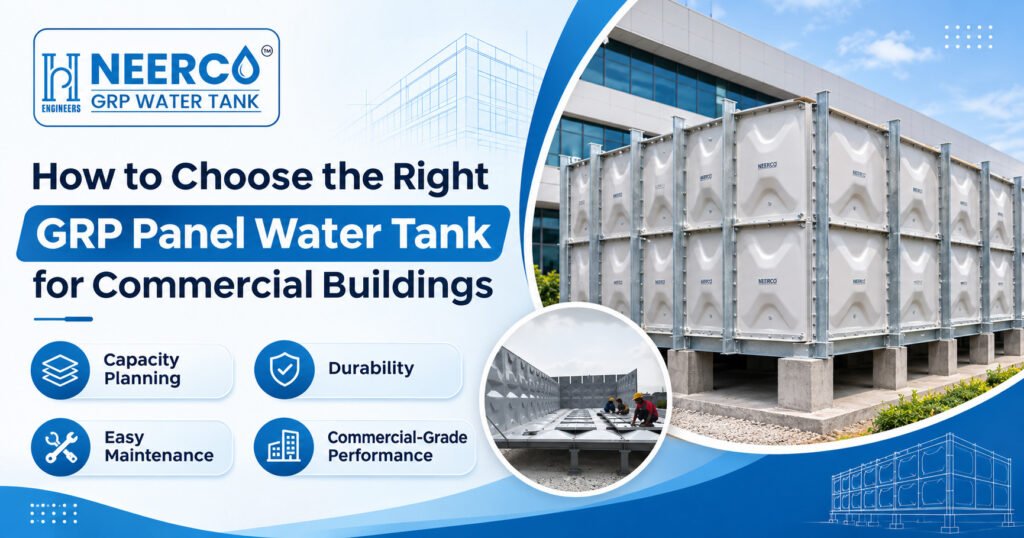
To choose the right GRP panel water tank for a commercial building, first calculate capacity from the number of occupants and their daily water demand, storage days and any fire reserve. Then check specifications (IS 14399-compliant panels, food-grade resin, correct panel thickness for the tank height, galvanised or stainless steel supports and potability test reports), plan the dimensions to fit the space with 1 m or 0.5 m panel modules, and compare prices on total installed cost, warranty and after-sales support.
Every commercial building depends on reliable water storage. Offices need water for washrooms, pantries and cooling systems. Hotels and hospitals need it around the clock for guests, patients and kitchens. Malls, schools and IT parks have hundreds or thousands of people relying on uninterrupted supply every day.
A GRP panel water tank is one of the most practical ways to provide that storage. Made from glass reinforced plastic panels bolted together on site, it’s lightweight, rust-free, hygienic and easy to fit on rooftops, in basements or at ground level, even where access is tight.
But choosing the right tank involves more than picking a size from a catalogue. This guide explains how to calculate GRP water tank capacity, which GRP water tank specifications matter, what affects GRP water tank price in India, how to plan tank dimensions and installation, and where GRP tanks work best in commercial buildings.
It’s written by the team at H P Engineers, which manufactures SMC and GRP panel water tanks under the NEERCO brand at GIDC Chhatral, Gandhinagar, Gujarat. Our tanks have been supplied to commercial and industrial projects for clients including Oberoi Realty, Lodha, The Leela, Schneider Electric and Reliance.
Understanding GRP Water Tanks
What Is a GRP Water Tank?
A GRP water tank is a water storage tank made from glass reinforced plastic: polyester resin reinforced with glass fibre. Most commercial projects use a GRP sectional water tank, also called a GRP panel tank, in which individual panels are bolted together on site with food-grade sealant and supported by a steel base and internal or external bracing.
Types of GRP Water Tanks
| Type | Description | Typical commercial use |
| SMC panel tank | Panels hot-press moulded from sheet moulding compound; consistent and smooth on both sides | Drinking water in offices, hotels, hospitals and malls |
| Hand lay-up GRP panel tank | Panels made by hand in open moulds; easier to customise | Custom shapes, non-potable storage |
| One-piece GRP tank | Moulded as a single unit | Small capacities where access allows |
| Insulated GRP panel tank | Panels with an insulation core | Temperature-sensitive storage, exposed rooftops |
| Partitioned tank | One tank divided internally | Separate domestic, flushing and fire storage |
In India, hot-press moulded GRP sectional tanks are covered by IS 14399. Learn how SMC and conventional GRP compare in our guide to SMC vs GRP panel water tanks.
Advantages of GRP Water Tanks in Commercial Settings
- Corrosion-free: No rust, unlike steel tanks, even with treated or chlorinated water.
- Hygienic: Smooth, opaque panels resist algae and bacteria and are easy to clean.
- Lightweight: Less load on rooftops and podiums than concrete or steel.
- Modular: Panels can be carried through stairwells and lifts and assembled where needed.
- Flexible capacity: From a few thousand litres to several lakh litres.
- Partitionable: One tank can serve domestic, flushing and fire needs separately.
- Fast installation: Days rather than the weeks needed to build and cure an RCC tank.
- Easy repair and expansion: Damaged panels can be replaced and capacity increased later.
- Long life: Well-made SMC panel tanks typically last 25–30 years.
Key Considerations for Choosing GRP Water Tanks
1. Capacity Requirements for Commercial Buildings
GRP water tank capacity should be based on actual demand, not guesswork. The National Building Code of India (NBC 2016, Part 9) gives typical daily water demand figures:
| Building type | Typical daily water demand |
| Offices (with canteen) | 45 litres per person |
| Shopping malls | 45 litres per staff member + 15 litres per visitor |
| Restaurants | 70 litres per seat |
| Hotels (up to 3-star) | 180 litres per bed |
| Hotels (4-star and above) | 320 litres per bed |
| Hospitals (up to 100 beds) | 340 litres per bed |
| Hospitals (above 100 beds) | 450 litres per bed |
| Hostels and boarding schools | 135 litres per person |
| Day schools | 45 litres per person |
Per-bed figures exclude staff and visitors, which should be added separately.
Steps to calculate capacity:
- Count users: staff, visitors, beds or seats.
- Calculate daily demand: users × litres per person per day, plus extra uses such as HVAC make-up, landscaping and kitchens.
- Size the underground or ground-level sump: daily demand × storage days (often 1 day for reliable municipal supply, 2–3 days for borewell or tanker supply), plus a 10–20% margin.
- Size the overhead tank: typically one-third to one-half of daily demand for multi-storey buildings.
- Add the fire reserve separately, as required by your local fire authority.
- Add freeboard: about 150–300 mm of empty height above the water level.
Our water tank capacity calculation guide explains this method in detail.
Example: an office building with 500 staff
- Daily demand: 500 × 45 litres = 22,500 litres
- Sump (1.5 days + 15% margin): 22,500 × 1.5 × 1.15 ≈ 38,800 litres
- Overhead tank (one-third to one-half of daily demand): about 7,500–11,250 litres
- Fire reserve: as specified by the fire authority, sized separately
2. GRP Water Tank Specifications to Look For
| Specification | What to check |
| Panel standard | Compliance with IS 14399 for hot-press moulded panels, with test reports |
| Material strength | IS 14399 minimums: tensile strength 70 MPa, bending strength 100 MPa |
| Glass content | At least 30% by weight in the moulding compound under IS 14399 |
| Panel thickness | Thicker panels at the bottom of deeper tanks (IS 14399 Types A, B and C) |
| Resin | Food-grade resin for drinking water |
| Potability | Test reports for taste, odour, toxic metals and microbial growth |
| UV protection | UV-stabilised outer surface for rooftop tanks |
| Insulation | Insulated panels where temperature control matters |
| Sealant | Non-toxic, food-grade sealant |
| Fasteners and stays | Hot-dip galvanised or stainless steel |
| Base structure | Engineered steel base frame or level concrete plinth |
| Accessories | Manhole, vent, inlet, outlet, overflow, drain, ladder, level indicator |
Under IS 14399, panel type depends on tank depth. A 1 m deep tank uses Type A panels throughout, while 2 m and 3 m deep tanks use thicker Type B and Type C panels in the lower courses. See our guide to IS 14399 requirements for SMC panel tanks.
3. GRP Water Tank Price in India
GRP water tank price in India depends mainly on capacity, height, location and specification. A July 2026 cost guide by Studio Matrx puts large modular bolted-panel tanks (10,000 litres and above, including GRP) at about ₹6–₹12 per litre, plus base and assembly. RCC underground sumps were listed at about ₹8–₹20 per litre all-in.
| Price factor | How it affects cost |
| Capacity | Larger tanks cost less per litre, as volume grows faster than panel area |
| Height | Taller tanks need thicker lower panels and more bracing |
| Panel type | SMC suits standard sizes; hand lay-up suits custom shapes |
| Location | Rooftop tanks need stronger steel bases and lifting |
| Partitions and accessories | Add panels and fittings |
| Insulation | Insulated panels cost more |
| Installation and testing | Site access, height and leak testing |
| Freight | Distance from the factory to site |
Figures are indicative only. Always compare quotations for the same capacity, panel standard, accessories and scope, and check whether the steel base, installation, testing and GST are included.
Selecting the Right GRP Panel Water Tank
Sizing and Dimension Considerations
Because panel tanks are built from standard modules, usually 1 m × 1 m, with 0.5 m sizes for fine-tuning, you can design almost any rectangular footprint.
Length and width:
- Measure the available area, leaving clear space around the tank for access and maintenance, typically at least 500–600 mm on the sides where bolts and stays need to be reached.
- Choose dimensions in 1 m or 0.5 m increments.
- Check the floor or slab’s load capacity with your structural engineer. Water weighs about 1,000 kg per cubic metre, plus the tank and base.
Height:
- Taller tanks fit more water in a smaller footprint, but need thicker panels and stronger bracing.
- Rooftop tanks are often kept lower to limit structural loads and wind exposure.
- Allow for freeboard above the water level.
Example dimensions for the 500-person office:
| Tank | Dimensions (L × W × H) | Gross volume | Usable at 1.8 m water depth |
| Overhead tank | 3 m × 2 m × 2 m | 12,000 litres | 10,800 litres |
| Ground sump | 6 m × 4 m × 2 m | 48,000 litres | 43,200 litres |
Installation Factors
- Base preparation: A level concrete plinth or engineered steel base frame.
- Access: Panels are carried by hand, so check stairwells, lifts and openings.
- Assembly: Floor, wall and roof panels bolted together with sealant.
- Bracing: Internal stays or external bracing to resist water pressure.
- Connections: Inlet, outlet, overflow, drain and vent pipework.
- Leak test: Filling the tank and checking every joint before handover.
- Seismic and wind design: Essential for rooftop tanks. See our guide to earthquake-safe rooftop water storage.
Choose a manufacturer that provides drawings, supplies the steel base and installs with its own trained team. Learn about our installation and service support.
Questions to Ask Your Tank Supplier
- Are the panels SMC (hot-press moulded) or hand lay-up GRP, and do they comply with IS 14399?
- Which panel types and thicknesses will be used at each level of the tank?
- Can you share potability and mechanical test reports?
- Is the steel base frame included, and how is it protected against corrosion?
- Are installation, leak testing and handover drawings included?
- What warranty do you offer on panels and workmanship?
- How quickly can you supply spare panels or attend a service call?
Maintenance Factors
- Clean and disinfect drinking water tanks about every six months.
- Inspect sealants, bolts, stays and the steel base for leaks or corrosion.
- Keep manholes and vents closed and screened against dust, insects and birds.
- Check overflow and drain lines regularly.
- Replace damaged panels promptly.
- Keep records of cleaning and inspection for audits and facility management.
Common Applications of GRP Water Tanks in Commercial Buildings
| Commercial building | How GRP tanks are used |
| Corporate offices and IT parks | Rooftop domestic tanks, flushing tanks and fire reserves |
| Hotels and resorts | Large partitioned tanks for rooms, kitchens and laundry |
| Hospitals and clinics | Hygienic drinking water storage and emergency reserves |
| Shopping malls and multiplexes | High-capacity domestic, flushing and fire storage |
| Schools, colleges and hostels | Rooftop and ground-level tanks for students and staff |
| Restaurants and food courts | Clean storage for kitchens and washrooms |
| Data centres | Cooling water and fire protection storage |
| Mixed-use and residential towers | Separate tanks for commercial and residential sections |
| Airports, metro and railway stations | Large modular tanks in restricted spaces |
Typical Commercial Scenarios
- Rooftop retrofit: Replacing a leaking RCC tank on an occupied office building, where panels can be carried up stairs and assembled without cranes.
- Basement installation: Fitting a large sump through a narrow access opening.
- Partitioned storage: One tank with separate compartments for domestic water, flushing water and fire reserve.
- Phased expansion: Starting with one capacity and adding panels as occupancy grows.
See more on our applications and clients pages.
Conclusion
Choosing the right GRP panel water tank for a commercial building starts with accurate capacity planning and ends with reliable installation and maintenance. Calculate demand using recognised figures, specify IS 14399-compliant panels with food-grade resin and the right thickness for the tank height, design dimensions around standard panel modules and your available space, and compare prices on total installed cost and long-term value.
Done well, a GRP water tank for commercial buildings gives you hygienic, leak-free storage for decades, with the flexibility to partition, repair or expand as your building’s needs change.
Planning water storage for a commercial project? Explore H P Engineers’ GRP panel tanks and SMC panel tanks, or contact our team for capacity planning, drawings and a free quotation.
Frequently Asked Questions
GRP water tanks don’t rust, are lightweight, hygienic and quick to install, and can be built in almost any size. They’re easy to partition, repair and expand, which suits commercial buildings with changing needs.
Multiply the number of users by their daily water demand (for example, 45 litres per person for offices under NBC 2016), multiply by the storage days you need, add a margin for growth, and add any fire reserve separately.
A July 2026 cost guide puts large modular panel tanks (10,000 litres and above) at about ₹6–₹12 per litre, plus base and assembly. Actual prices depend on capacity, height, specification, location and scope.
Well-made SMC panel tanks typically last 25–30 years with regular cleaning and inspection. Lifespan depends on material quality, UV protection, installation and maintenance.
GRP tanks have a long service life, are light to transport and prevent leakage, which reduces waste. Like other thermoset composites, they can’t simply be melted and recycled, but established routes such as cement kiln co-processing can recover the glass and resin at end of life.
A GRP sectional water tank is built from individual glass reinforced plastic panels, usually 1 m × 1 m, that are bolted together on site to form a tank of the required size.
Standard IS 14399 panel sizes are 1 m × 1 m, 1 m × 0.5 m and 0.5 m × 0.5 m. Tank dimensions are planned in these modules, so length, width and height are usually in 0.5 m steps.
Yes. GRP tanks are well suited to rooftops because they’re light and modular. They need an engineered steel base, UV-stabilised panels and a structural check of the roof slab.
Yes. A partitioned GRP tank can hold separate compartments for domestic, flushing and fire water, provided the fire reserve meets local fire authority requirements and can’t be drawn for daily use.