
Water scarcity has become one of the most pressing challenges facing the world today. In countries like India, where the monsoon lasts only a few months, effectively capturing and storing rainwater has become essential rather than optional. Rainwater harvesting is the process of collecting rainwater and storing it safely for future use – whether for drinking, household chores, irrigation, or industrial processes. However, the success of any rainwater harvesting system depends heavily on one critical factor: the choice of the right storage tank.
This is where SMC Panel Tanks (Sheet Moulding Compound Panel Tanks) come into the picture. Built using modern composite technology, these tanks have emerged as a far more durable, hygienic, and cost-effective water storage solution compared to traditional options. In this blog, we’ll take a detailed look at why SMC panel tanks are becoming the preferred choice for rainwater harvesting storage.
Why Rainwater Harvesting Matters
Rising water demand and steadily falling groundwater levels have turned rainwater harvesting from a nice-to-have into a necessity. Some key reasons include:
- Declining groundwater levels: Urbanization and excessive extraction are pushing groundwater tables lower every year.
- Water scarcity: Many cities and villages face acute water shortages during summer months.
- Climate change: Erratic rainfall patterns make it more important than ever to capture water when it’s available.
- Regulatory requirements: Several states and municipalities now mandate rainwater harvesting systems for new construction.
All these factors point to one conclusion: simply collecting rainwater isn’t enough. It also needs to be stored safely and hygienically for extended periods – and that’s where the quality of the storage tank becomes critical.
What Are SMC Panel Tanks?
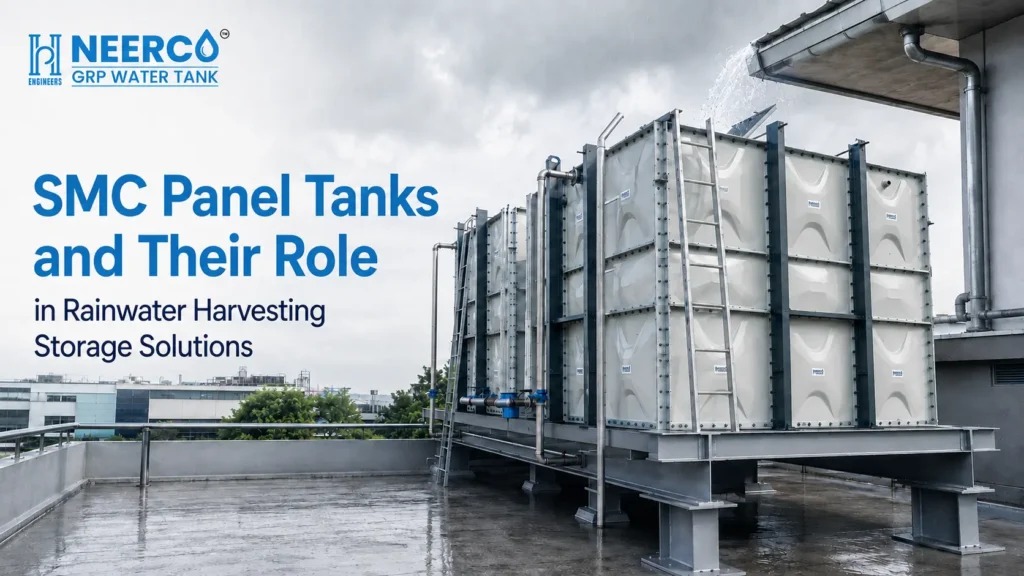
SMC, or Sheet Moulding Compound, is a composite material made from fiberglass-reinforced polyester resin. Panels made from this material are bolted together to form a large, strong, leak-proof tank. These tanks follow a modular design – small individual panels are joined together to create a tank of virtually any size or capacity.
Compared to traditional RCC (Reinforced Cement Concrete) tanks or steel tanks, SMC panel tanks represent a next-generation storage technology that is rapidly gaining popularity across construction projects, residential societies, hospitals, hotels, and industrial facilities.
Structure of an SMC Panel Tank
An SMC panel tank is typically made up of the following components:
- SMC Panels – form the walls, roof, and base of the tank.
- Reinforcement Structure – steel or FRP (Fiber Reinforced Plastic) support framework that adds structural strength.
- Sealing Gaskets – rubber gaskets fitted at panel joints to prevent water leakage.
- Bolts and Nuts – used to securely fasten all panels together.
Key Advantages of SMC Panel Tanks
1. High-Quality, Corrosion-Resistant Material
SMC panels are corrosion-resistant, meaning they don’t rust – a quality that makes them ideal for long-term use in both sunny and humid environments.
2. Modular Design and Easy Installation
Because these tanks are built from small individual panels, they can be assembled almost anywhere – on rooftops, in basements, or in tight spaces. While traditional RCC tanks can take weeks to construct, SMC tanks can typically be assembled in just a few days.
3. Maintains Water Hygiene
Algae and bacteria don’t easily grow on SMC surfaces, which helps keep stored water clean and safe for a longer period. This makes them suitable for both drinking water storage and general household or industrial use.
4. Customizable Capacity
SMC panel tanks are available in a wide range of capacities – from a few thousand liters for residential use to several lakh liters for large industrial applications. The number of panels can be increased or decreased to match exact capacity requirements.
5. Lightweight Yet Strong
Compared to RCC or steel tanks, SMC panel tanks are significantly lighter. This makes them easy to install even on rooftops without putting additional structural load on the building.
6. Low Maintenance
Once properly installed, SMC tanks require minimal maintenance. The risk of cracking or leakage is much lower compared to traditional concrete tanks.
7. Long Lifespan
High-quality SMC panel tanks can last 20-25 years or more without major issues, making them a solid long-term investment.
8. Environmentally Friendly
Since SMC tanks are made from recyclable materials and require less energy to manufacture, they are considered a more environmentally sustainable option compared to conventional concrete tanks.
SMC Panel Tanks vs. Traditional Storage Tanks
| Feature | SMC Panel Tank | RCC Tank | Steel Tank |
| Installation Time | A few days | Several weeks | Moderate |
| Corrosion/Cracking | None | Cracking possible | Rust-prone |
| Water Quality | High, hygienic | Algae growth possible | Can be affected by rust |
| Long-Term Cost | Economical | Higher (repair costs) | Higher |
| Portability | Can be assembled/disassembled | Not possible | Difficult |
| Weight | Lightweight | Very heavy | Heavy |
| Customization | Easy | Difficult | Limited |
This rcc tank and smc panel tank comparison makes it clear that while the initial cost may vary slightly, SMC panel tanks come out ahead in the long run – in terms of maintenance, water quality, and overall reliability.
Where Are SMC Panel Tanks Used?
- Residential Societies and Apartments: To meet the daily water needs of large housing complexes.
- Industrial Facilities: For process water storage and fire-fighting systems in factories.
- Hospitals and Schools: Where a continuous supply of clean water is essential.
- Hotels and Resorts: To manage large-scale water consumption efficiently.
- Agricultural Sector: For storing harvested rainwater used in irrigation.
- Municipal Water Supply: For community-level water storage in smaller towns and cities.
How to Choose the Right SMC Panel Tank
When selecting an SMC panel tank for a rainwater harvesting system, keep the following factors in mind:
- Assess your water requirement: Determine tank capacity based on the number of family members or the scale of industrial use.
- Check space availability: Choose a design suited to where the tank will be installed – rooftop, ground level, or underground.
- Verify material quality: Ensure the panels are food-grade and UV-resistant.
- Choose a reliable manufacturer: Buy from a company that offers a solid warranty and dependable after-sales service.
- Installation support: Confirm whether the company provides professional installation and maintenance services.
Conclusion
Rainwater harvesting is no longer just an environmental responsibility – it’s a fundamental necessity for the future. The success of the entire system largely depends on how well and for how long the collected water can be stored safely. This is exactly where SMC panel tanks deliver – offering strength, hygiene, easy installation, and low maintenance, all in one solution.
Whether you’re looking for a compact tank for a home or a large-capacity storage system for an industrial facility, SMC panel tanks are a reliable, durable, and future-ready choice. With the right planning and the right tank, we can not only conserve water more effectively but also help secure a better water future for generations to come.
FAQs
1. What is the price of an SMC panel tank per litre?
In India, pricing works out to roughly ₹8-₹10 per litre for 1,000-5,000 litre tanks, ₹7-₹9 per litre from 5,000-25,000 litres, and ₹6-₹8 per litre above 25,000 litres. So a 20,000-litre tank costs about ₹1.4-₹1.8 lakh. Foundation, piping and filters are usually quoted separately.
2. What size SMC panel tank do I need for rainwater harvesting?
Use this formula: roof area (m²) × rainfall (mm) × 0.8. A 200 m² terrace catching a 60 mm shower yields around 9,600 litres -so a 10,000-litre tank fits. SMC panel tanks are built in 1-metre modules, so round up to the nearest size, such as 3m × 2m × 2m for 12,000 litres.
3. Can a single damaged panel be replaced instead of the whole tank?
Yes, and this is one of the biggest practical advantages of the modular design. If one panel cracks or a joint starts leaking, that panel is unbolted and swapped on its own – usually within a day, without emptying or dismantling the full tank. An RCC tank offers no equivalent repair option.
4. Is an SMC panel tank the same as an FRP or GRP tank?
Largely yes – the names describe the same family of composite tanks. FRP and GRP refer to the fibreglass-reinforced material itself, while SMC refers to the sheet moulding process used to press the panels. SMC panels are hot-press moulded, which gives more consistent thickness and strength than hand-laid FRP panels.
5. How often should an SMC panel tank be cleaned?
Twice a year is ideal for rainwater harvesting storage – once before the monsoon and once after, since that’s when silt and leaf debris enter the system. Also check bolt tightness and gasket condition once a year. A first-flush diverter and inlet mesh filter cut cleaning work down sharply.